Wednesday, March 30, 2022

Making Your Walks Safer!

I have so many wonderful online friends within the collie community.  We share stories and photographs of our collies and support one another from puppyhood, through adolescence and adulthood, all the way to the rainbow bridge.  While many of the stories shared in that space are happy and upbeat, there have been a few that were upsetting, not because of what was said, but because what had happened was so preventable.  What am I talking about? I'm talking about how to protect yourself and your dog out on walks and hikes.  

You already know that I am not a fan of dogs meeting each other when on leash. Dogs on leash pull and strain, making their faces appear tense and their body postures more rigid.  Dogs greeting each other off leash have looser, more open body language.  I especially don't like off leash dogs that run up to leashed dogs.  This creates unnecessary stress for the leashed dog and their owner.  The off leash dog's owner hollering, "My dog is friendly!" isn't helpful at all. While your dog may indeed be friendly MOST OF THE TIME, what if he isn't this time?  What if the leashed dog he's charging isn't friendly?  What if the owner of the leashed dog is afraid of unleashed dogs?  If you let your dog off leash, they must have perfect recall so that when they move toward a leashed dog, you can call them back before they engage.  If you can't do that, then don't let your dog off leash. Period.  And it goes without saying that if you are in a park or area designated as strictly for use by leashed dogs, DON'T LET YOUR DOG OFF LEASH.  Just because your dog likes being off leash, doesn't mean other people on the trail or in the park will appreciate your dog (and you) not abiding by the clearly marked rules for use of that space.  People who don't like to be around off leash dogs, or whose dogs aren't comfortable with that, will not be at parks, trails, or dog parks where off leash dogs and their owners are allowed to congregate.  Respect that.

So, first and foremost, if someone with a dog on leash approaches you with your dog on leash and asks if they can meet, firmly but kindly tell them that you don't let your dog greet dogs while on leash, no exceptions.  They may be offended, but that's their problem not yours.  Once again, they may think their dog is friendly, or may want to socialize their dog to other dogs, but that isn't your job.  Your job is to make that walk safe for yourself and your dog.  I have clients whose dogs serve as their emotional support animals, as well as dogs who serve as service animals for their owners.  They do not want to risk a negative encounter with another dog as this adversely effects their dog's ability to do their job for that owner.  I was never more sad or angry than when my client with a service dog had her service dog attacked at the airport, and subsequently her service dog has so much anxiety around travel that he can no longer support her in that environment. 

If you are approached by an off leash dog while your dog is on leash, do make your discomfort known by telling their owner to leash them, but be prepared for their dog not to listen.  Do not tighten up on your dog's leash as that will signal them to alert.  If you can slowly and safely move away, do so.  If not, stand between their dog and yours.  Carry an airhorn (one of those $5 New Year's Even party ones will do, or you can get the kind used of boats to signal distress) with you at all times so that you can blast it toward the approaching, offensive dog.  The noise will scare them off and alert others in the area to the problem.  If the other dog's owner is upset that you blasted their dog, so be it.  You've done no permanent damage as could occur with mace or pepper spray; you've simply stunned their dog into understanding why they shouldn't just run at other dogs. Airhorns can be invaluable on hikes as well, alerting others to any problems you might encounter, from snakes on the trail to mountain lions in the area. 

If you are a regular trail walker, you can also carry a walking stick with you. The stick can be waved at an approaching dog to back them off. If need be, the stick can be thrust into the side of the aggressor's mouth to get him to let go of your dog as he ultimately bites down on the stick.  Don't be tempted to hit the approaching or aggressive dog with the stick as this could cause the dog to either increase their aggression toward your dog, or result in them turning on you instead. 

What should you do if a fight does occur?  Drop the leash. Give your dog a chance to fight back or retreat.  Don't try to separate the dogs with your hands or other body parts as you will get bit.  If there are two people there, you can wheelbarrow the dogs apart (grab the back legs, raise them up and walk the dogs backwards; they will have to let go of each other and focus on walking on just their front legs).  If you are alone, do not attempt the wheelbarrow method, instead use your airhorn or walking stick to separate the dogs.  Resist the urge to grab collars as this could not only result in you getting bit, but can most definitely result in worse injury to the dogs involved as they tighten their hold when attempts are made to separate them through collar grabs. 

One last thing to always try preemptively BEFORE any of the above happens:  throw an obvious handful of treats away from you and your dog in an effort to redirect that off leash dog approaching you.  Most dogs will at least trot off to sniff what you tossed, giving you time to move away.  And I honestly don't care if that off leash dog eats something he shouldn't that you tossed his way; that's his owner's problem for letting him charge at you in the first place.  Bottom line?  Always carry treats and an airhorn so you are prepared for all encounters.

Being a responsible dog owner means being prepared for all possible outcomes, making your walks as safe and fun as possible for you and your dog. Stay safe out there and, as always, if you have questions about your pet's behavior, you know where to find me. 

Nothing more fun than a bunch of off leash collies enjoying their free time at a Collie Fun Day! Here is Ozzie laying next to a beautiful sable-headed white collie while a few other sables trot around.


Wednesday, March 23, 2022

Why Can't I Just Punish My Dog?"

I actually laughed when my new client asked that question, albeit in frustration. You see, she just retired and her kids gifted her an adolescent dog to keep her company.  While my client is clearly a dog person, she wasn't necessarily ready for this dog, a high-energy, head-strong, Shepherd mix.  She told me she'd punished her kids when they drove her nuts, but everything she's read says she shouldn't have done that (LOL!) and she certainly shouldn't punish her dog.  She wanted to know what she SHOULD do then, if her dog misbehaves or is defiant.  I'm awfully glad she asked (and that she said it was okay to share her story here!).

I'm not going to dive deep into a discussion of positive reinforcement, versus negative reinforcement, versus punishment.  Suffice it to say, there's a ton of research on this topic.  Here are just a few bullet points from a summary study in the Journal of Veterinary Behavior 3, no. 5 (2008) that  I want you to remember:

  • Owners who use only positive reinforcement when training their dogs are the least likely to report behavior problems such as aggression, fear, etc.
  • The most pronounced levels of aggression and fear were reported in dogs trained using the balanced training method (balanced trainers use a combination of positive reinforcement and positive punishment.  Positive punishment refers to you adding in something after your dog does a behavior, like kneeing a dog who jumps up, in an effort to get them to stop jumping on people).
  • Regardless of size of the dog, owners who use punishment note more aggression and excitability in their dogs.
  • Dogs whose owners use positive reinforcement in the form of treats, are quicker to learn new behavioral tasks than those whose owners used other forms of positive reinforcement (petting and/or verbal rewards) or punishment. 
  • Dogs trained using punishment are less playful with their owners and less interactive with new people.
And finally:
  • More than one study has found that confrontational dog training methods result in dogs who respond aggressively, attend less to their owners, and show heightened stress responses.
So, no matter how frustrated my client was with her dog, yelling at him, yanking his leash, or swatting him on the nose wasn't going to improve his behavior, and might in fact make it worse.  Fine, she said.  Then what should she do when he surfs the kitchen counters, won't come inside when called, pulls her down the street on leash, and charges at other dogs? I'm pretty sure you already know what I told her.

Dogs who surf counters should not be left unattended in the kitchen.  Dogs need boundaries and structure; he couldn't surf the counters if he was in his pen, crate, or tethered to her.  And if he did try to surf when tethered to her, she could say "OFF" and redirect him to what he should be doing.  She could also teach him the place command so he has to stay on his mat during food prep. If he gets up, he gets a time out away from her.  Social shunning (time spent away from us) is by far the best "correction" to use if you must use a correction.  First, however, show your dog what they should be doing by using redirection; it's only when they refuse to do that, that a time out is warranted. 

Won't come when called?  Why aren't they on a leash or long line then?  Any dog without good recall needs to be tethered for their own safety, even in your own yard.  Use an upbeat voice and treats to reinforce coming when called. I actually did this on a long line with my client's dog and he came EVERY TIME I CALLED.  Yep.  The magic of chicken jerky!

Leash pulling and charging at other dogs will be a work in progress for my client.  We needed to get him into a different kind of harness to begin with, and added in a head halter as well, thus walking him using two leashes.  She will need to walk at off peak times in off peak places while she encourages her dog to sniff and explore rather than pull and charge.  We will be adding in relaxation and resetting techniques for them both as we move forward with their training. 

My grandmother used to say "You get more flies with honey than you do with vinegar," meaning if you're nice, you'll get more of what you want.  When it comes to training dogs, you'll get more reliability and happier pooches with treats than with harsh leash corrections and a smack on the nose. Don't get me wrong; I know we all make mistakes, yanking our dog away from something on the sidewalk or yelling at them to slow down so we can dry their feet.  Don't worry about those little blips, just make sure that they are the exceptions and not the rule in your interactions with your dogs.  And remember, you can always give yourself a time out as well, if you need it.  Nothing in the world wrong with that.

As always, if you have questions about your pet's behavior, you know where to find me.  
                                 
These two floof-balls love training exercises.  Here we were working on a dropped leash stay for Westley and a no leash stay for Ozzie.  We definitely dished out treats when we released them from the stay as you can clearly see, they were relaxed and happy to stay in place, even with distractions on the trail that day.


Wednesday, March 16, 2022

She'll Outgrow This, Right?

I received a phone call from a new client.  She has had her 5 month old puppy since she was 9 weeks old.  During that time, the puppy has shown herself to be timid with new people, avoidant of other puppies in puppy class, and "snappy" with her children, ages 8 and 10.  When the client visited her veterinarian for the puppy's next round of vaccines, she told her vet all of this and said, "She'll outgrow this, right?  This is just how puppies are when they are little, right? That's what I've read online."  Her veterinarian handed her my card and suggested she reach out to me immediately for guidance and I'm really glad that she did!

While puppies most certainly outgrow their collars (and often their dog beds!), they do no outgrow their personalities or burgeoning behavior problems.  While it certainly isn't unheard of for a puppy to avoid other puppies or hide during puppy class at times (I've written on the topic before), adding in being timid with people too AND snappy with kids and I've got some real concerns about this puppy in this home.  We set a time to meet when her children weren't home, just in case what I had to say wouldn't be what they wanted to hear about their new puppy.

This puppy wasn't timid, so much as she was uninterested in people.  She would take treats from me, when offered, but then went right back to looking out the window or chewing on her toy.  I asked the owner if she was hiding during puppy class or avoiding everyone and doing her own thing, like I was seeing there at home.  She said the puppy just did her own thing while the others ran around and played; if they approached her she would freeze and stare at them, or move away slowly until they lost interest in her. She also moved away from interacting with other people or the instructor during class.  I asked the owner to show me what things they had worked on with the puppy as I really wanted to see if this puppy would engage with her owner.  My client approached her puppy and then called her; this puppy looked up from the toy and went right back to chewing on it.  I told the owner to go ahead and take the toy away so the puppy could focus on her.  She hesitated and that's when I knew.  This puppy is already showing resource guarding in this home as well.  She is snappy not just with the kids, but with anyone who tries to take a toy or bone from her, or move her when she's laying down.  I asked if anyone had actually been bitten, and the owner reluctantly admitted that they all had.

Dogs that bite people are deal-breakers for me, particularly in homes with children as it isn't safe for them or their friends and really puts a lot of undue stress on the family to micromanage their dogs with issues in aggression toward people.  While I often suggest confidence building exercises for timid puppies, controlled social experiences for those lacking the skills to explore on their own, lots of mental exercise, and an enforced nap schedule, none of these activities will change this puppy, and she most certainly will not be outgrowing these issues.  This is a purposefully bred puppy, so this aloof personality and resource guarding aggression most likely have a genetic component.  It certainly isn't anything my client or her children have done.  It was time to contact the breeder and return this puppy in order to keep everyone safe.  

I feel bad for her kids as they really wanted a puppy and have been doing "everything right," from attending puppy classes as a family, to a white board at home dividing up puppy related tasks among all family members.  The problem isn't the family, it's this puppy.  And while that's a hard pill to swallow, it's the truth.  No amount of love, classes, naps, or schedules will change the temperament of this puppy.

I do feel that this family is ready for a puppy.  My hope is that they will let me help them find the next one and we'll be able to choose one whose personality and temperament are better suited to family life.  

As always, if you have questions about your pet's behavior, you know where to find me.

While puppy personalities vary from introverted to gregarious (just like people!), certain personalities don't mesh well with certain living environments.  Breeders like to decide what puppy goes where, but I honestly think some of them aren't doing their homework when making those placements.


Wednesday, March 9, 2022

The Stress of Pet Ownership

There always seems to be a lot of talk about how great pets are for their owners, reducing anxiety, lowering heart rate and blood pressure, etc. But pets don't always reduce their owners' stress; sometimes our pets can make our stress even worse. For pet owners whose pets have behavior problems, feelings of aggravation and frustration are often the norm, giving them social anxiety (worrying about what other people think of them because their pet has issues) and making them feel overwhelmed. Pet owners whose pets have both minor and major behavior problems report feeling frustrated, depressed, and even angry, at times with their pets.  Keep in mind that feeling frustrated, angry, or depressed is understandable, but our pets can pick up on these feelings and respond with even more anxiety themselves, thus leading to further or more pronounced behavior problems, particularly for issues related to separation anxiety.

I met with a client last week whose life has been turned upside down.  Her husband passed away, she had to move out of the home they'd shared for almost 50 years, and she was trying to adapt to living in a senior apartment with the young dog that her husband had acquired just a year before he'd passed away.  She was not only reeling from all of these changes, she was also trying to deal with the burgeoning behavior problems this dog now has.  He'd been an active, enthusiastic puppy, but her husband loved that in the dog, and spent hours playing with the puppy, taking him on beach walks, and teaching him tricks.  Now, they live in the suburbs, don't have a yard, and she's trying to adapt to senior living, in close proximity to people she's just met. She's having trouble because this dog barks, jumps up on people, and pulls hard on the leash.  Her neighbors have reported her dog for his barking and that's been incredibly upsetting for my client as she feels like everyone is out to get her. She feels judged when she walks her dog because he pulls to meet people and then jumps up on them.  She doesn't want to give up the dog as she does love him and sees him as all that she has left of her husband, but she also doesn't want to be forced out of her new living environment.  Her veterinarian had suggested she reach out to me for help.

I had this client and her dog meet me at a local park.  As I approached them, her dog started bouncing around and pulling.  It was all she could do to hold onto his leash!  As I was introducing myself, she literally burst into tears!  I felt terrible for her; this dog wasn't purposefully "being bad," he just didn't know how to control his enthusiasm.  I asked for her dog's leash and told her she could just watch us work together until she felt comfortable jumping in.

I switched out his 4 foot leash which was too short for nice walking and sniffing in favor of a 6 foot ThunderLeash.  I dropped a few treats, encouraging him to sniff them out on the grass. This helped him to relax a bit so he could focus.  I used treats to lure him into a nice loose leash heel around people at the park, and he did great!  I encouraged sniffing and exploring and gave him enough leash to sniff without feeling rushed. At this point, I put him on a 20 foot line, so we could practice his recall and so that he could explore even more without feeling too restrained. This dog was clearly missing the freedom he'd had with his own backyard! His owner was amazed at how well he did with me.  I started teaching him a few tricks, just for fun.  As we continued to work together, I watched my client relax.  She began to smile.  She even clapped and giggled a few times.  Success!

I gave this owner a straightforward plan that she could follow.  I outlined where, when, and how long to walk her dog.  I suggested feeding him in puzzle toys instead of a bowl.  She will enforce nap times for him so he stays well-rested.  She will stand on his leash for greetings and move from that 4 foot leash to the longer ThunderLeash for better control.  She will let him sniff and explore, both on leash and on a long line. She will carry treats at all times and use them to reward and to lure into good behavior, and to help him remember the value of sniffing.  We also talked about his barking which I feel is the result of both boredom and uncertainty with his new home environment. Frequent short walks, puzzle toys, and tricks training should help with the boredom and make being in their new home more comfortable.  She can stand on his leash for greetings so he won't jump up, and encourage people to pet him under his chin and offer him treats for sitting or standing nicely. She will start pairing her time away from him with fun things like bones, bully sticks, and frozen Kong toys.  She will reinforce the crate as his happy, safe place and have him sleep in there at nap times and bedtime. 

My client feels hopeful.  She really wants to keep this dog and honor her husband's memory.  He was "the dog person," but she does enjoy the dog's company and feels like he could be a healing companion for her.  Our next meeting will be at her senior residence so we can work around the obstacles there and I can smooth the way with her neighbors. 

I will do everything I can to help this client and her dog succeed.  I want to help her heal and find joy again and I do truly believe that this young, happy-go-lucky dog can help her achieve that end.  

As always, if you have questions about your pet's behavior, you know where to find me.

Having a healthy, happy relationship with your dog takes work, but it's worth it!


Wednesday, March 2, 2022

Keeping Your Dogs Employed!

I worked with a client over the weekend and his adolescent dog.  During the appointment, I commented that his dog needed a job other than tearing up patio furniture cushions, digging under the fence, and pulling out prized plants by their roots.  He said he hadn't realized that his dog was "unemployed!" We got a good laugh out of this, but truly, sheer boredom was the root cause of all of his dog's "bad" behaviors.  And, again, ripping things with his teeth, digging, etc. are not "bad" behaviors to a dog, they are just dog behaviors.  Most dogs love ripping stuff up and digging to their heart's content.  This doesn't mean you just have to put up with your dog turning your yard into a wasteland, rather you need to give them a job that suits their skillset.  Diggers need to dig, climbers need to climb, and runners need to run.  You get my drift, I'm sure.  So, here are my suggestions for getting your dogs a "day job:"

For dogs who like to dig: Time to either designate an area of your yard for digging, or set up a space for them to do so.  It could even be an old sand box your kids don't use any more, or a plastic wading pool that you repurpose for digging.  Fill the sandbox or wading pool with your dog's favorite digging substrate (clean dirt, sand, etc.) and then bury fun things there for them to find such as bones, baby carrots, or bully sticks. If you catch them digging where they shouldn't, redirect them to the appropriate area.  Make digging in those areas less satisfying by laying down netting, adding in large rocks, or putting up fencing to discourage digging in the wrong areas.  And remember, if you are digging in an area, they will want to dig there too as you've obviously chosen the best spot!  Keep your dog indoors when you do your spring planting and remember to supervise them in the yard until they are regularly choosing their designated digging area without you leading them there.

For dogs who like to run:  Flyball and lure coursing are two sports that are perfect for dogs who like to run.  Lure coursing is great for dogs who like to perform alone, while Flyball is a team sport.  For Flyball, dogs basically compete relay style, one team versus another, with dogs jumping over jumps to get to the special box at the end, tag it with their feet to release a ball, grab that ball and run back, which then triggers the next dog to run. Really fun to watch and participate in and the jump height for the jumps is set to the smallest dog on the team's shoulder height.  Most teams have a fast, little dog to keep those jumps at a reasonable height for sailing over quickly.  Lure coursing is just what it sounds like.  There is an artificial lure that races around a course and your dog chases after it, fastest time wins!  Think about those racing greyhounds chasing the fake bunny around a track and that gives you an idea of what lure coursing is like for your dog.

For dogs who like to climb: Hikes in mountainous terrains are great, if you like to climb too, but if you can't climb, or you don't live near steep trails, then agility, or even parkour, might be a great sport for your dogs.  Agility is an individual sport, with points for time and accuracy.  Even if you don't compete, your dog will have fun jumping over jumps, climbing a-frames, balancing on teeter-totters and dog walks, and zipping through tunnels. Parkour courses are basically agility done with objects found in the real world such as hay bales, picnic benches, drainage tunnels, traffic cones, etc. 

For dogs who like to sniff:  Nosework is the ideal sport for dogs who love to sniff .  Whether they are sniffing for unique smells like cedar or birch in a nosework class, or sniffing out a rat in a hidden cage in Barn Hunt, your nosey dog will have an appropriate outlet for the behavior with these two options.  Given that most dogs love to sniff, these two sports are good for almost any dog, and are really wonderful for older dogs who still have the drive to work, but may not have the stamina or vision any more to do other tasks.

For water-loving dogs: Dock diving is a terrific sport to pursue with dogs who love the water.  A floating toy is thrown in the water for your dog to race along a dock and jump as far out into the water as they can to retrieve the toy.  You'll get great practice at throwing the toy further and further out as your accuracy and distance at throwing the toy, will help push your dog to jump further out into the dock diving pool!

For dogs who love meeting new people: Pet assisted therapy is the perfect job for dogs who love meeting new people and can be trusted not to jump up on them, mouth them, etc.  Pet therapy is particularly well-suited to dogs who aren't put off by strange smells (think hospital smells) odd human behavior (think people with dementia, shaky hands, or unsteady gaits), or medical equipment around them like wheelchairs, walkers, canes, etc. While many people think the ideal pet therapy dog is a small dog who will sit on someone's lap, the truth of the matter is that big dogs, medium dogs, and every size in between can make great pet therapists for various environments. For example, while a German Shepherd or Great Dane might seem like the perfect candidate for a hospital setting where the patients are in beds and those larger dogs will be able to position themselves alongside the beds easily for petting, a medium sized dog can do this too, she may just need to be taught to sit in a bedside chair for better access!

Obviously, this is not an exhaustive list of dog jobs, but just the tip of the iceberg.  There are so many great options that you can pursue with your dogs depending on their aptitude and your schedule.  I purposefully did not include links to local clubs/events for these pursuits because not everyone following this blog is located in the San Francisco Bay Area.  If you are, however, here in the Bay Area, and you want a suggestion on where to pursue one of these jobs for your dog, send me a message, and I'll make sure to send you a place to start.

As always, if you have questions about your pet's behavior, you know where to find me.

Desi is a natural at pet assisted therapy.  He can work his magic on the elderly, the infirmed, and kids of all ages.  He is also a somewhat trustworthy babysitter, though he does often fall asleep on the job!


Wednesday, February 23, 2022

More 5 Minute Training Fun!

I've received a handful of requests for more five minute training ideas.  I love that you all are embracing the notion of shorter training sessions, focused on fun exercises to help your dog be more successful on your walks, in your home, etc.  This time around, I thought it might be fun to pick five 5 minute training ideas that focus on getting your dog more mental and physical stimulation, moving beyond walks, sniffiaris, and puzzle toys.  So, here you go!

1.  Fun with leave it/drop it: Gather a bunch of items your dog might be tempted to sniff, pick up, or destroy; I like to use boxes, wadded up aluminum foil, used paper plates, used kitchen sponges, old dish towels, socks, bones or toys past their usable dates, highlighter pens, ball caps, etc.  You get the idea. With your dog in another room, spread these items around on the floor, then bring your dog in on leash and walk them around and through all of the items like a gauntlet. Your goal is to be able to use your voice (and treats!) to redirect them away from picking up any of the items on the floor; resist the urge to tug their leash to get them to leave the items. Sniffing is okay, of course, but picking stuff up should be met with a happy "drop it!" and redirection. See if you saying "leave it!" alone is enough to get your dog to move on.  If they can do this easily on leash, try off leash.  Definitely try the same exercise outdoors, at the park, etc., basically anywhere you go where your dog might find fun stuff on the ground to sniff, but should not pick up.  This is a wonderful exercise for dogs of any age, but keep in mind that puppies will likely pick up everything they encounter the first few times you do this, so definitely keep them on leash, have high value treats to trade, and make sure that the objects you are using for the game are too large to be swallowed!

2.  Where's the cookie?:  Put your dog in another room or in their crate where they can't see what you are doing.  Take a good sized dog cookie or treat and hide it in plain sight in the room.  Bring your dog back to the room and tell them to find the cookie.  They should be able to quickly find it the first time using their eyes and nose.  Be sure and verbally reward the find.  Each time you hide the cookie, make finding it more difficult; placing under dog beds, in toy bins, in the sliding door track, etc. which means your dog has to work harder to find the reward.  If you want to add another layer to the game, start giving your dog hints like "you're getting warmer!"  or "you're getting colder!" as you redirect them in the general direction of the treat.  They will learn to look to you for those hints if they are having trouble finding the cookie.  Make it even harder by taking this game outdoors and putting the cookie under a piece of patio furniture, under a soccer cone, inside your kids' playhouse, etc.  There are so many great smells outdoors, this will be a much bigger challenge!  

3.  Interval Training:  Dig out those old soccer cones as you'll need about 12 for this exercise.  Six of the cones will be set up in one part of your yard, with cones spaced about 2-3 feet apart.  They can be in a straight line, or wavy, your choice.  In six other areas of your yard, place a single cone.  Label each of those six cones (Station 1, Station 2, and so on).  Now, grab six solo cups and a bunch of scrap paper.  For each solo cup you will want 5-6 different tasks written on paper and tossed in the cup.  Some stations should be harder and/or more active than other.  For example, Station 1 might be ask for a sit then a down. Pretty easy, right?  When you get to Station 2, however, expect the activity to ramp up as this station's cup is filled with tasks like "do a circle left around the cone, then circle right."  Station 3, is your goofy station, so the cup should have ideas like "march with your dog," "get your dog to jump in place while you do jumping jacks," etc.  Head to Station 4, for a controlled exercise like a distance stay.  Station 5, is all about tricks so make sure those pieces of paper in the cup have things like rollover, shake, high five, etc. or more advanced tricks if your dog can do them!  The cup at Station 6 is filled with new things you'd like to teach your dog.  Maybe you want them to offer their foot for inspection; do a loose leash heel; pick up a dropped item; etc. From this last station, you can move to the "weave cones" and guide your dog through them saying "weave" or "through."  Start out on leash doing it with them, but move up to being able to send them through the cones on their own.  Big praise and rewards at the end!  Be sure and mix up those ideas you've written on paper and placed in those solo cups and change them up regularly as well.  And no cheating when you reach into the cup for your task; do the task on the first piece of paper chosen!

4.  Silence is Golden:  This is just charades for dogs.  Start out inside your house, but work up to doing this outdoors where there are other distractions.  Set a timer for 3-5 minutes.  During that time, and until you hear the ding, you cannot use any words with your dog.  You must use your body language, hand signals, and facial expressions to convey your messages.  Start with the easy stuff like sit, down and stay, since I'm sure you have hand signals for those things already!  How about come?  Do you pat your legs, snap your fingers, or whistle to get your dog to come to you?  Try them all to see what works best, getting the fastest recall.  If you haven't been using hand signals for other behaviors, go ahead and use a treat in your hand to lure your dog into the behaviors, but quickly move past the lure to an actual hand signal.  Use your hands to guide your dog to stand at your left and then come around behind you to the other side.  Signal a good job to your dog with a thumbs up gesture and a big smile on your face!

5.  Backyard Parkour: You can use almost anything for this exercise, but these items are my favorites: hula hoops, picnic table benches, foldable chairs, adjustable beach umbrellas, large sturdy buckets, cement blocks or bricks that can be stacked on two sides with a broom, large PVC pipe, or 2 x 4 positioned across them. Spread out your parkour items in your yard!  Hula hoops can be laid on the ground for practicing sit/stay and down/stay in place or you can teach your dog to pick up an item and drop it inside the hoop.  Your other hoop can be held up so your dog can jump (or walk!) through it.  For the picnic table bench, teach your dog to put their feet up, and then to climb up and walk across the bench, stop and then hop down.  Once they can do this, see if they can turn around on the bench and move back the direction they came.  Can they walk the bench backwards?  Add in a bow?  For the foldable chairs, either spread them out for weaving between, or leave them folded and lean them against each other or a wall and have your dog walk through/under them them without knocking them down.  For the beach umbrellas, have your dog crawl or walk under the open umbrella stuck into the ground. If they are afraid of umbrellas, start by moving around them first and build up to going under them. For the buckets, teach your dog to balance with their front feet on the upside-down buckets.  Little dogs can be taught to jump up on a bucket with all four feet, and maybe even sit up on it!  For larger dogs, just the front feet is fine.  You can also use the buckets to play a larger version of the shell game.  Put some treats or kibble under one bucket so that when your dog get to the bucket, she realizes there is an added bonus for turning that bucket over!  Play the limbo game with the broom/PVC pipe/board across the cement blocks.  Keep lowering the broom to see how close to the ground your dog can crawl without knocking over the broom. Now reverse it!  Start raising the broom on the blocks for jumping over without knocking over the broom! If you don't have any of these objects, or your yard is too small for parkour, get creative at a community park, using playground equipment when the neighborhood kids aren't there, picnic tables and benches not being used, weave around trees or bushes, crawl under tables, and plant feet on art in the park, water fountains, trash cans, etc.  See a large rock?  Have your dog put his feet up on it!  Found a stump?  Time to get your dog to balance up there!  Hey, there's a puddle!  Let's jump over it!  I'm sure you get the idea.

Each of these five exercises allows your dog to use their brains and their bodies to solve problems, stay active, and have fun.  They can be customized for puppies or for senior dogs as well.  These exercises are also great for building confidence in a shy dog, or for bonding with a recent rescue. And remember, the goal of these exercises isn't to do them all in five minutes flat.  Rather, it's to do something fun with your dog that challenges their mind and body for five minutes each day. 

As always, if you have questions about your pet's behavior, you know where to find me.

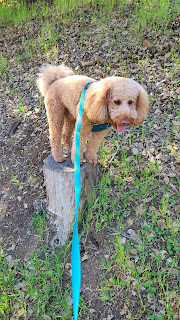
Here's my Saturday buddy, Loki, doing a bit of impromptu parkour on a stump
 we found during a recent training session 


Wednesday, February 16, 2022

Teaching Cooperative Care to Puppies & Kittens

I had another long conversation with a veterinarian friend this week.  She was having a few problems with one of her own pets, a senior cat, needing weekly fluid therapy and meds. This cat is fairly easy to handle at home, but becomes very fractious in the hospital setting.  She knows that stressing him out at the office won't help him, but she can't do what needs to be done for him at home; it's got to be done at the clinic.  This started a conversation about the importance of cooperative care and teaching our pets when they are young to accept the kind of handling necessary to give them pills or vaccines, but also to administer ear and eye medications, and even take x-rays. We both agreed that it is frustrating, even for us, when you know giving your pets medication stresses them out.  We both know that our clients experience similar frustration as well. Plus, there are animals who behave aggressively toward their owners, as well as their veterinarians, whenever any medical procedures need to be accomplished.  I know that your veterinarian has the option to muzzle or sedate your pet for what needs to be done in a veterinary hospital, but do you really want those added stressors for your pet?  And how will you do the post operative care and/or medications at home?

Cooperative care allows an animal to take an active role in the process of their grooming or medical needs.  It gives them the opportunity to make choices before, during, and after their care and see the consequences of their choices.  I'm going to tell you right off the bat: this is a tedious process.  You can't work on cooperative care with your pet 10 minutes before you need to medicate them; it's something that you want to be teaching them everyday and incorporating into your daily training and handling exercises. As with anything new you want to teach your pet, it's a lot easier to teach them when they are younger and haven't had many negative experiences to color their perceptions of handling.  Consequently, I think teaching exercises in cooperative care should be part of every puppy class, kitten kindergarten, and new puppy or kitten appointment at a veterinarian's office. If we start when our pets are young and eager to please, our grooming sessions and necessary veterinary care will be so much easier (and less stressful!) when they are mature.

So, what basic behaviors do you want to teach? First off, teaching your pet to stand for examination is important.  Hold a treat in front of their nose if they are sitting and move the treat toward you as you say "stand."  Hold the treat for them to chew on as you move your hands lightly over their bodies. If they back away, sit, etc., no more treats.  

Your next step will be to teach your puppy or kitten to place their head/chin in your hand.  This is fairly easy, as most kittens and puppies enjoy a nice face rub.  Put your hand out and wiggle your fingers to get them to approach, use a treat in your other hand to get them to hold that position for a few seconds to begin with, then give them the treat. Work up to longer periods of holding steady in your hand before giving the treat.  Add in touching the ears and eyes to the process ONLY AFTER YOU'VE GOTTEN THE CHIN REST BEHAVIOR SOLIDLY IN PLACE.  If your pet removes their head from your hand, nothing bad happens, but the treats go away.  If you have a dog, you will want to move past this to teaching your dog to put their head on a lap or on a raised pillow on the floor or a chair.  Do it the same way; lure them into position and build up to longer periods of holding their head/chin on the lap, chair, or pillow.  Always use high value treats and no treats if they can't remain still in place. If you want to take this a step further, you can place a cloth on the chair, pillow, or lap you are practicing this behavior on.  Look at or point at the cloth and reward your dog for approaching, sniffing, touching, and then ultimately resting their head on the cloth.  That way, you can take this cloth to the veterinary hospital, if needed, to help your dog execute the same behavior in that setting; the cloth becomes the place cue for the behavior you are looking for.  You will want to assign a verbal marker for this behavior as well.  It can be as simple as the word "rest, relax, or chill" or be specific to the body part "chin please." In order to make this work across situations, you will want to add in distractions and practice in different locations.  For puppies and kittens learning the chin rest, you can ultimately use this behavior to provide routine ear or eye cleaning, even if they don't require medication, to continue to reinforce the behavior. 

The next behavior you will teach your puppy or kitten is to offer a paw.  This is valuable for nail trimming as well as for blood draws.  Start with simply holding the paw and work up to squeezing the paw, pinching the foreleg (desensitizing them to needle pokes),  touching individual nails, etc. The key factor here again is giving the animal the option to say "No, I'm not comfortable with that." Since you are basically teaching your pet to target (i.e. target your hand, the cloth on your lap, the pillow, etc.), they learn that all they need to do to signal their discomfort is move away from the target; they don't have to growl, snap, bite, or flee. Of course, the high value rewards go away too, but that's how they learn that their behavior has direct consequences.

To me, cooperative care is nothing more than a fancy term for shaping, that is rewarding an animal for successive approximations to your desired goal.  In this case, you are rewarding your pet for relaxing and submitting to routine care; they can stop the process at any time, so they don't need to panic.  This is critical because if they are ill or injured, panicking may be their first choice, but if they've been taught to rest calmly, you may be able to get them the care that they need without provoking additional distress. 

There are resources online that include videos you can watch to help demonstrate what I've described above, adding in specific training for things like administering liquid medication, cleaning and medicating ears,  brushing and nail trims.  I'd recommend starting here: 

https://karenpryoracademy.com/tag/cooperative-care/

I'll be meeting with a client next week to help her teach her dog to allow ear cleaning and medicating.  You see, he isn't aggressive when she tries to work with his ears, he actually gets profoundly anxious and then depressed, and will hide in a closet following any ear treatments.  Since he gets routine ear infections, he needs his ears cleaned daily, at a minimum.  It's gotten to the point where he sees her gathering the ear cleaning products, and he's already high tailing it to hide in the closet!  It will take more than one session to help this dog, but my hope is that we can, at a minimum, teach him the chin rest behavior so that the owner can continue to work on her own, at her dog's pace, to get him to the point where his ears can be cleaned routinely. 

As always, if you have questions about your pet's behavior, you know where to find me.
Ozzie is very good about cooperative care.  He understands that he can say no at any time, but that going along with ear cleaning, eye wiping, teeth brushing, body grooming, and nail trims will earn him special treats.  Plus, he likes to put his long nose in my hand or on my lap even without treats!